What a Scene Lets You Hear Outside the Room
Learn to hear offscreen sound in film: track what lies beyond the frame and notice how a few carefully placed sounds widen the space of a scene.
The common mistake with offscreen sound in film is to treat every noise as part of the room shown on screen. That can make a passing bus, a hallway door, or a voice beyond a wall seem like background decoration. Listen instead for how each sound connects the visible room to a place the camera leaves unseen.
On a rewatch, keep your eyes on the room and ask where each sound seems to come from. Separate what a character could plausibly hear from music or effects added for the audience. Then note whether the sound suggests a specific place or simply makes the room feel open to the world outside it.
Offscreen sound in film gives a room a boundary
A visible wall is not automatically a meaningful edge. Sound can suggest that it separates one space from another. Muffled conversation through plaster points toward a neighboring room. Footsteps that grow louder and then fade suggest a corridor. A latch heard before anyone enters makes a doorway feel active, even while it remains out of frame.
Listen for changes as a sound seems to cross a boundary. A voice may begin indistinct, become clearer as its speaker approaches, then lose detail after the person passes. That shift suggests distance and movement. It can also reveal what the characters know: they may hear someone approaching before they can see who it is.
For a brief listening note, record the apparent source, its relation to the room, and whether it changes while the shot holds. Do not force a definite answer when the film keeps the source unclear. “A low mechanical hum beyond the wall” may be more accurate than naming a machine the image never establishes.
Direct sound and implied space do different work
Direct on-screen sound is tied to something visible in the shot: a cup set down, a chair dragged across the floor, or a person speaking. The image lets you match sound to source. An unseen sound asks you to make that match yourself, or to accept that the source remains unknown.
That difference shifts your attention. A clink from a visible glass directs you toward an action in the room. A clink from outside it pulls your attention toward a place the camera withholds. The sound may create curiosity, but it need not become a mystery or a clue. Sometimes it simply keeps the scene from feeling sealed off.
Notice how the soundtrack treats each kind of sound. A visible action may be crisp and close, while traffic outside is softened by windows. If both are equally clear, the mix may be asking you to attend to the traffic as much as the conversation. If the outside sound stays faint, it may work as a reminder that the room has a world around it.
Distance comes from changes, not volume alone
Loudness can suggest proximity, but it is only one cue. A distant voice may lose consonant detail. Footsteps may sound sharper on tile than on carpet. Traffic filtered through a closed window can have a duller edge than traffic heard from an open doorway. Notice these qualities before deciding that a sound is simply “far away.”
Movement matters too. A vehicle that swells and recedes suggests passage along a route; a steady engine suggests something idling nearby. Repeated footsteps moving from one side of the stereo field to another can sketch a path, though a mono or tightly centered mix may keep that movement less precise. Sound can suggest geography without drawing a map.
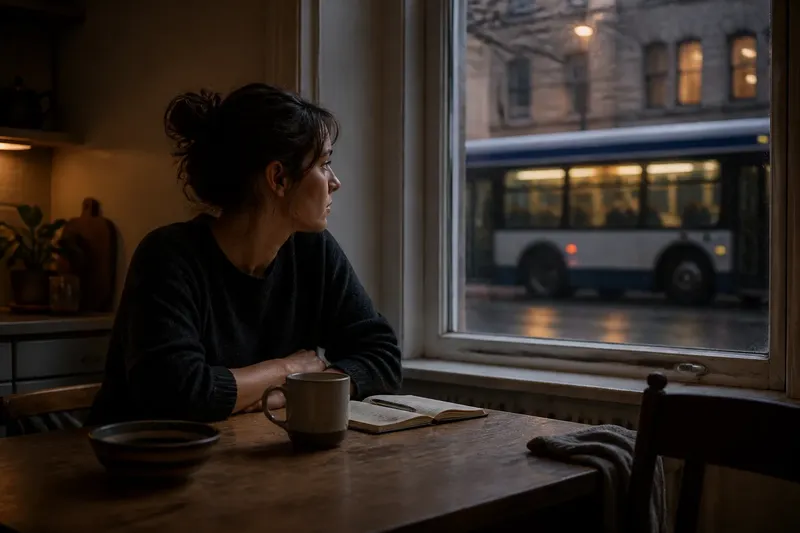
Imagine a character sitting at a kitchen table while a bus passes outside. The rumble rises, briefly masks a line, then fades. You can infer a street close enough to interrupt the conversation, even though the film never leaves the kitchen or shows the bus. The interruption may also make the character’s pause feel less like silence and more like waiting for the outside world to pass.
What can you infer from a sound beyond the frame?
How can you tell whether a voice is in another room?
Listen for softened speech, reduced clarity, and a change in level as the voice approaches or recedes. An opening door may sharpen the sound, but a film can suggest a nearby room without showing or opening the door.
Does every unseen sound point to a specific location?
No. A steady rumble can establish that the room is not isolated without telling you whether it comes from a road, ventilation, or distant machinery. Keep your description at the level the scene supports.
Why can an unseen sound seem closer than its source should be?
The mix may bring a sound forward so the audience notices it, even if the imagined source is distant. Compare it with the visible dialogue and room tone before treating its prominence as literal distance.
What should you do when you cannot identify a sound?
Note its texture, rhythm, and effect on the scene instead of guessing. “Intermittent metallic knocks interrupt the pause” is useful even when the film never explains who or what makes them.
Silence can make an unseen place feel occupied
A scene does not need a clear sound from outside the room to imply a larger world. Listen for what remains under dialogue: a faint ventilation wash, distant traffic, the soft hiss of a building, or a brief quiet after a door closes. These low-level sounds can keep the space from feeling acoustically empty.
Notice whether room tone continues when characters stop speaking. If it does, the pause still belongs to a physical environment. If the background drops away sharply, the sudden quiet can draw attention to a look, a decision, or a moment of strain. The absence itself becomes noticeable because the scene has prepared you to hear a surrounding space.
Silence is not always a blank soundtrack. A near-silent scene may still hold small details, such as fabric shifting or a breath from just outside the frame. Those sounds can make the unseen feel close, but they do not automatically identify a person or explain what that person intends.
Track how the scene uses a sound over time
On a second viewing, pick one sound and follow it from its first appearance to its last. Ask whether it begins before the image reveals the room, continues through a change in dialogue, or stops when a character makes a decision. A sound that starts early can establish the surrounding environment; one that cuts off abruptly can make the room feel newly isolated.
Notice whether characters react. A glance toward a door, a pause mid-sentence, or a lowered voice can suggest that a sound belongs to their world. If nobody responds, the sound may be aimed mainly at the audience, or it may be ordinary background noise that the characters have learned to ignore.
Say you are rewatching a scene in which two people argue at a counter while a dog barks outside. The barking recurs between lines, and one person briefly looks toward the window. You can note that the sound interrupts their exchange and places the counter near an exterior space. You need not invent a neighbor, a street, or a reason for the dog to bark. The observable relationship between the bark, the pause, and the glance is enough.
Keep listening notes precise and modest
Separate the sound from your interpretation. Write “three dull knocks beyond the closed door” before writing “someone wants to come in.” The first records what the scene gives you; the second is a possibility, not a fact. If the film later clarifies the source, revise your interpretation without losing the original observation.
- Check whether the sound is clearly tied to something visible. If it is, record the visible source; if it is not, describe it as offscreen rather than assigning an identity.
- Check the sound’s texture, such as muffled, ringing, airy, rough, or intermittent. If one quality stands out, use it in your note; if none does, describe the rhythm or level instead.
- Check when the sound enters, changes, and stops relative to the shot and dialogue. If it shifts with an action, note that relationship; if it does not, record that it continues unchanged.
- Check whether a character reacts with a glance, pause, or change in speech. If someone responds, note the reaction; if nobody does, leave the characters’ awareness uncertain.
- Check whether the film identifies a likely location or source. If it does, name only what the scene establishes; if it does not, keep your note at the level of texture and position.
- Check whether the sound alters attention, tension, or the sense of privacy. If it does, describe the change; if it does not, treat the sound as part of the scene’s surrounding atmosphere.
It is not worth trying to name every faint noise or assign an exact distance from a finished mix. If a source never becomes clear, pressing for a solution can flatten uncertainty the scene deliberately leaves open. Focus instead on what the sound changes: attention, tension, privacy, or the sense that life continues just beyond the frame.
Offscreen sound in film is most revealing when you follow its boundary and timing, not when you guess at an unseen story. Say you note a low hum, a pause in dialogue, and no character reaction; the sound supports a sense of nearby activity, but not a definite source or location. Keeping that distinction lets you hear the scene’s world without claiming more than it gives you.