The Object That Returns Before You Notice
Track a recurring object in a film without treating every appearance as a clue, and see how changing context can quietly reshape its meaning.
The common mistake in tracking a recurring object in a film is to decide too soon that it is a clue. That can turn ordinary continuity into a puzzle hunt and make you miss the more interesting change: the same object can feel different because the scene around it has changed. A simple appearance log helps you notice that shift without assigning the filmmaker an intention you cannot verify.
What counts as a recurring object in a film?
A recurring object is a recognizable thing that appears more than once and gains attention through repetition. It might be a red scarf, a chipped mug, a key, a framed photograph, or a particular kind of flower. The object does not need to dominate the frame. It only needs to be identifiable enough that you can reasonably say, “That is the same one,” or “That belongs to the same visual pattern.”
Keep two categories separate in your notes. An exact return is the same prop or unmistakably the same item: the character carries the same umbrella from one scene into another. A visual echo is a different object with a related shape, color, or use, such as several round mirrors appearing in unrelated rooms. The second category can be suggestive, but it is weaker evidence of a deliberate motif.
Repetition alone does not settle the question. A glass may reappear because a character keeps using it, because the scene is set in the same kitchen, or because the production needs consistent dressing. You can still track it. The point is to describe what is on screen before deciding what it means.
Why can the same object feel different each time?
Meaning gathers through context. An object beside a relaxed conversation may seem ordinary; the same object left untouched after an argument can draw attention to absence, interruption, or a changed relationship. The prop has not necessarily changed. Its placement, handling, visibility, and the viewer’s knowledge have.
Watch for four kinds of contextual change:
- Who handles it: Does a different character pick it up, avoid it, give it away, or leave it behind?
- Where it appears: Has it moved from a familiar room to a public place, a doorway, or an unexpected corner?
- How the camera presents it: Is it briefly visible in the background, held close, isolated in the frame, or passed over without emphasis?
- What has changed in the story: Does the audience now know something that gives the object a different association?
These observations do not amount to a fixed code. A locked box does not always mean repression, and a missing photograph does not automatically signal grief. Ask what this particular appearance adds compared with the last one. Sometimes the answer is simply “nothing noticeable,” which is a useful finding rather than a failure.
How do you track an object without turning it into a clue?
Use a short, neutral log. You can keep it in a notebook, a notes app, or a plain spreadsheet. Record the scene or a rough point in the film, what the object looks like, what it is doing, and what changes around it. Add an interpretation only after the description, and mark it as a possibility.
- Choose an object you can identify. Pick one with a distinctive color, shape, mark, or repeated role. Avoid starting with a broad category such as “all doors” unless that pattern is the subject of your viewing.
- Write down each appearance. Note the scene in ordinary language, such as “on the hall table during the arrival” or “in the passenger’s lap during the ride.” A scene description is more useful than a timestamp you may not remember later.
- Separate what you saw from what you infer. “She turns the key and sets it down” is an observation. “She is giving up control” is an interpretation. Keep both if useful, but do not let the second replace the first.
- Compare the appearances. Look for changes in owner, location, condition, handling, framing, and surrounding action. Note which details recur and which appear only once.
- Review the pattern after the film ends. Ask whether the sequence changes your understanding, creates a visual rhythm, supports continuity, or remains inconclusive. Leave room for more than one answer.
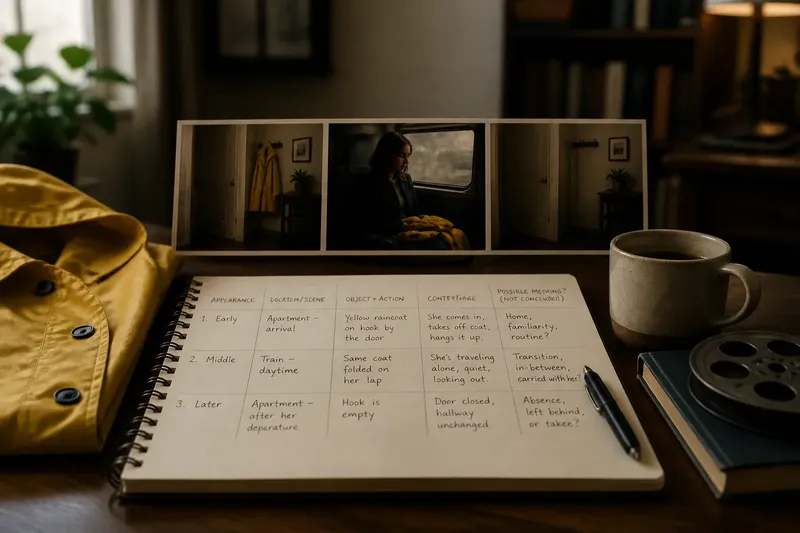
Say you notice a yellow raincoat hanging near the apartment door, then see what looks like the same coat folded beside a character on a train, and later spot it absent from the hook after that character leaves. Your log could record those three placements and the character’s actions without deciding that the coat represents escape. On a rewatch, you might notice the final absence matters because the hallway is otherwise unchanged; or you might conclude the coat was simply carried away. Either reading begins with the same screen evidence.
For a first pass, one object is usually enough. If you track several at once, the log can become a catalogue that obscures the film’s movement. It is not worth pausing after every background glimpse or replaying a scene until an uncertain prop becomes certain. Note the appearance when it catches your attention and keep watching.
What should you write down at each appearance?
Favor details you can check on screen. A compact entry might read: “Kitchen; the blue tin is open; Mara moves it from the counter to the shelf; the camera stays wide.” That gives you a location, a visible change, an action, and a presentation choice without claiming what any of them mean.
Include the surrounding relationship when it helps. Was the object shared, borrowed, hidden, returned, or ignored? Did a character notice it? If you cannot tell whether two appearances show the same prop, write “similar tin” rather than merging them into one. Uncertainty belongs in the record; it need not be resolved by guesswork.
It can also help to note a contrast. An object may be carefully centered once and barely visible later, or appear in the same place while the characters behave differently around it. These changes can support an interpretation, but they do not prove one. Your notes are a map of the pattern, not a verdict on the film’s intention.
How can you tell a motif from ordinary continuity?
You often cannot tell with certainty from one appearance, and you do not need to. Continuity is the work of keeping a scene coherent: a cup remains where a character left it, a coat travels with its owner, or a tool returns because the plot still needs it. A motif is a repeated element that becomes expressive through how the film uses it. The same object can serve both purposes.
Look for a pattern rather than a single striking moment. Does the object recur at meaningful changes in a relationship or situation? Does its use shift? Does its framing invite attention, or does its appearance create a visual connection between otherwise separate scenes? These questions help you judge how much interpretive weight the pattern can bear. They do not reveal a hidden rule.
Also consider practical explanations. A prop may be visible because the action requires it, because the setting makes it natural, or because the film wants the space to feel lived in. Those explanations do not cancel a motif. They simply keep the reading proportionate. A recurring object can gain resonance as a by-product of the story’s ordinary details.
What questions help when an appearance is ambiguous?
Does a recurring object always symbolize something?
No. It may support continuity, establish a character’s habits, give a setting texture, or carry a meaning that remains open. Describe the repetition first and treat symbolism as one possible reading, not the automatic result.
Should you track every appearance?
Record appearances you can identify, but do not interrupt the film to investigate every uncertain glimpse. If a possible return is too brief or obscured, mark it as uncertain and move on.
What if the object appears only twice?
Two appearances can form a useful echo, especially when the second changes the first in retrospect. The small number does not make the link meaningless, but it does give you less to support a broad claim about the film.
How can you discuss the pattern without overstating it?
Point to the placement, handling, and scene changes you noticed, then describe your interpretation as a reading. “The key returns after the characters separate, which makes the earlier handoff feel more significant to me” is more precise than claiming the key has one settled meaning.
When does an object’s return matter most?
A return matters when it changes what you can notice, not merely because you can count it. The shift may be emotional, visual, or practical: a character now refuses an object they once accepted, a familiar prop appears in an unfamiliar place, or a previously unremarkable item becomes visible after the story gives it context. Sometimes the strongest pattern is the disappearance of an object you had learned to expect.
Keep your notes modest and revisable. If you are discussing the film with someone else, cite the scenes and distinguish the visible pattern from your interpretation. That makes room for disagreement without flattening the viewing into a hunt for the one correct answer.
The object that returns before you notice is often easiest to understand after you stop asking what it “stands for” and compare what happens around it. A clear appearance log gives you that comparison, while leaving the film free to be deliberate, incidental, or both.