A Second Look at the First Five Minutes
Rewatch a film’s first five minutes with a simple note-taking plan to see how its place, point of view, and opening question shape what follows.
The common mistake in a first-five-minutes rewatch is trying to explain every detail before the opening has finished. That turns a quiet evening into a hunt for clues and can make ordinary choices seem more meaningful than they are. A better rewatch of a film’s first five minutes has one modest purpose: notice how the opening establishes a place, positions your attention, and leaves a question worth carrying into the film.
Choose a film you already know, but do not review the plot beforehand. Have a notebook or a blank document ready, and keep the remote nearby. Watch the opening once without pausing. Then revisit it in short stretches, following the troubleshooting plan below. The aim is not to solve the film. It is to describe what the opening makes you expect.
Start with the whole opening before taking notes
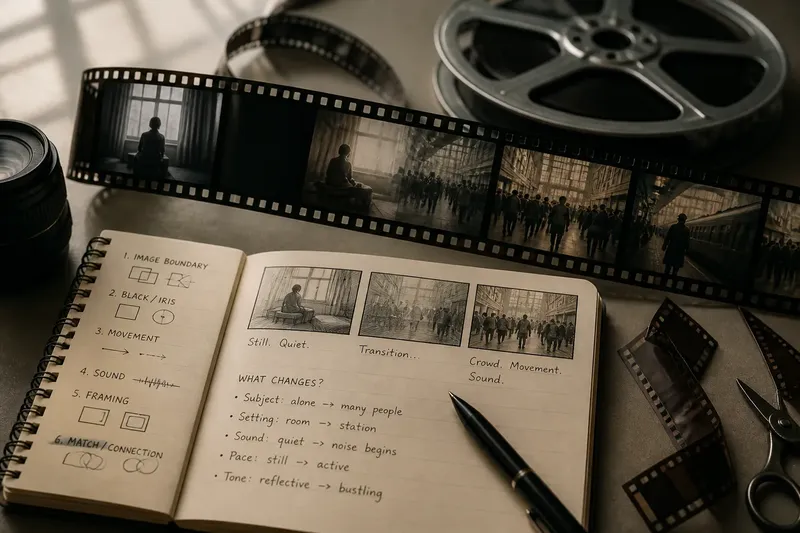
On the first pass, watch from the first image through the point where the film’s opening sequence clearly gives way to the next stretch. That may be a title card, a change in time or place, or simply a shift in what the film asks you to follow. Do not assume the first five clock minutes are a self-contained scene; the boundary is a viewing aid, not a rule about film form.
When the sequence ends, write three short observations: where you seem to be, whose attention organizes the scene, and what you are curious about. Keep these as plain statements. “A busy kitchen before a shift; I follow the new worker; will she recognize the person at the counter?” is more useful than “The kitchen symbolizes pressure.” The first describes what is visible and leaves room for the film to complicate it.
When the place feels too vague, track how it becomes legible
A setting may not announce itself with a clear establishing view. You might get a close shot of a hand on a railing, a doorway that opens onto a street, or a voice from somewhere outside the frame. That can make “Where am I?” feel difficult to answer. Do not fill the gap with a guess about the story’s intended meaning.
Replay the opening and note the concrete cues that help you orient yourself. Look for visible thresholds, repeated routes, changes in distance, and what characters can reach or see. Then separate the place you can identify from the place you can only infer. “A room connected to a hallway” is an observation; “a hospital corridor” is a stronger claim and needs evidence in the image or sound.
Try one focused replay rather than scanning the scene repeatedly. Pause after a shot that changes your sense of location, then write what changed. If no clear answer emerges, record that uncertainty. A film can keep its geography incomplete while still making you understand whether a character is entering, waiting, hiding, or leaving.
When you cannot tell whose point of view matters, follow attention
Point of view is not always the same as the camera’s literal position. The camera can show a room while a character’s reaction tells you which part of it matters. Or it can withhold a face and make you share someone else’s uncertainty. If you keep asking, “Who is seeing this?” you may miss the simpler question: whose attention is directing the moment?
On a replay, watch for a character’s gaze, the timing of a reaction, and what the next shot lets you notice. Listen for a voice that belongs to someone outside the image, but do not assume that every offscreen voice controls the scene. Write down one sequence in ordinary terms: “She looks toward the doorway; the film shows an empty doorway; she stays still.” This records the connection without declaring what it means.
If the opening shifts attention between people, note the shift rather than choosing a single owner. A brief scene can invite you to watch one character’s actions, then make another person’s response more important. That change may be the opening’s way of setting the terms for how you will read later scenes.
When the opening question sounds like a plot quiz, make it smaller
“What happens next?” is a valid question, but it often produces a prediction rather than an observation. The more useful opening question grows from something the scene has already made you notice: why someone pauses at a door, what a character has not answered, or whether a meeting will continue after an interruption.
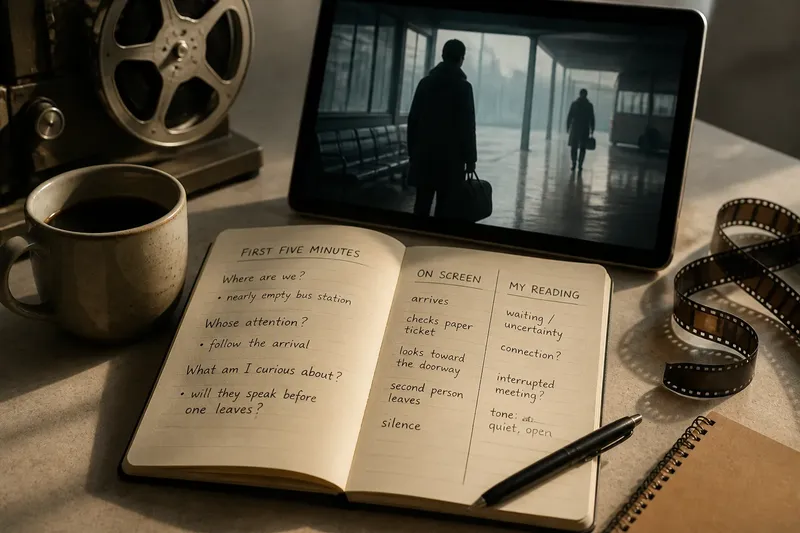
Say you revisit an invented opening in which a person arrives at a nearly empty bus station, checks a paper ticket, and watches a second person leave without speaking. Your first guess might be that the two know each other. For a more disciplined note, write: “Will they speak before one of them leaves?” The starting point is the arrival and the silent departure; the action is to phrase a question tied to visible behavior; the expected result is a note you can compare with the film’s later choices, without treating your guess as a prediction the film owes you.
Keep one question, not a list. It should be specific enough to revisit and open enough to survive a surprising answer. If the film never addresses it directly, that is still useful: you can ask whether the opening trained you to expect resolution, recognition, or simply continued uncertainty.
When your notes turn into theories, return to what the scene shows
A rewatch can tempt you to turn every framing choice into a hidden message. The background may be there to make a room feel occupied, not to encode a clue; a pause may reflect performance, pacing, or several things at once. The trouble is not interpretation itself. It is losing track of which part you observed and which part you inferred.
Use two columns if you need to separate them. Under “On screen,” write actions, sounds, spatial relationships, and changes in attention. Under “My reading,” write what those choices suggest to you. Keep the second column tentative. If an interpretation depends on a detail you cannot point to, set it aside instead of building a larger theory around it.
What is not worth the effort: pausing on every shot, cataloging every visible object, or searching for a definitive explanation of the opening before you have watched the rest. Those habits can interrupt the rhythm the film is establishing. One or two deliberate replays are usually enough for this exercise.
What should you do with the opening after the rewatch?
Should you stop at exactly five minutes?
Use five minutes as a convenient limit, not a claim that every film’s opening ends there. If a clear opening sequence continues a little longer, finish the sequence and note where your attention shifts.
Should you take notes while the film plays?
Watch the first pass without writing so you can feel the scene’s rhythm. Add brief notes afterward, then pause only when a replay can answer a specific question.
What if the opening does not give a clear location?
Record the limits of what you can identify, along with any visible or audible cues. Uncertainty about place can be part of how the film positions you, rather than a failure to watch closely.
How do you know whether an opening question is useful?
A useful question comes from an action, omission, or shift you can name in the opening. It gives you something to notice later without requiring one particular answer.
Carry one observation into the next scene
End the evening by writing a compact note with three parts: the place as you understand it, the attention the film asks you to follow, and the question you want to retain. Add one sentence about what remains uncertain. This keeps the rewatch grounded in the opening rather than turning it into a verdict on the whole film.
The value of revisiting a film’s first five minutes is not that the beginning contains a complete map of everything that follows. It is that you can see the film setting conditions for your attention. On another viewing, check whether those conditions still shape how you watch—or whether the rest of the film has changed what the opening seems to ask.